

A strong SEO strategy helps a brand improve search visibility, attract qualified visitors, and turn organic traffic into leads, sales, and sustainable growth.
A search result often decides which brand earns attention before a buyer visits any websiteA search result often decides which brand earns attention before a buyer visits any website.
Strong SEO can bring qualified visitors, leads, sales, and repeat demand while competitors remain unseen.
Modern SEO goes well beyond placing keywords on a page. It connects search intent, useful content, technical access, page experience, trust, and steady measurement.
The strongest strategy starts with business goals, improves the pages that matter, removes barriers that block search engines, and tracks actions that affect revenue. Google’s Search Essentials provide a useful foundation for crawling, indexing, content quality, and spam prevention.
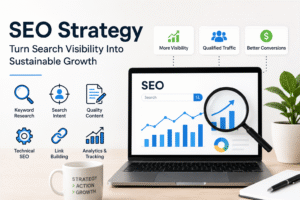
Build an SEO Strategy Around Search Intent and Business Goals
Effective SEO begins with the needs of your audience and the results your business wants. High search volume has little value when visitors have no reason to buy, subscribe, call, or return.
Define the Searchers and Outcomes That Matter
Identify your audiences, their problems, buying stages, locations, devices, and likely questions. Separate informational searches from navigational, commercial investigation, and transactional intent so each page answers the right need.
Set goals such as qualified leads, purchases, booked consultations, email sign-ups, or product discovery. Then group audience segments with the questions they ask at each stage of the customer journey.
Turn Keyword Research Into Topic Opportunities
Use seed terms, related searches, autocomplete, competitor pages, People Also Ask results, and industry language to learn how people describe their needs. Google Keyword Planner, Google Trends, Search Console, Bing Webmaster Tools, and trusted SEO platforms can reveal demand and gaps.
Group close variations by topic and intent instead of creating a page for every minor phrase. Prioritize topics by relevance, difficulty, business value, search intent, and the quality of current results.
Create a Search-Driven Content Architecture
Build a clear path with pillar pages, category pages, product or service pages, comparisons, FAQs, and supporting guides. Connect related pages with internal links so users and search engines can understand how information fits together.
When several pages target the same need, consolidate them or give each page a distinct purpose to reduce cannibalization. Record each important URL’s target intent, main topic, secondary questions, conversion goal, internal links, and update date.
Make Every Important Page More Relevant and Useful
On-page SEO should help readers find clear answers and help search engines interpret the page. The goal is to satisfy the query better than competing pages, not repeat a phrase until the copy becomes hard to read.
Match Content Structure to the Query
Use the format that fits the search: a definition, tutorial, checklist, comparison, calculator, category page, or service page. Answer the main question early, then add examples, proof, tables, and detail for readers who need more help.
Descriptive H2 and H3 headings, short paragraphs, and scannable sections improve clarity. Original value may come from firsthand testing, expert review, unique data, demonstrations, or a clearer explanation than existing results provide.
Optimize Titles, Descriptions, URLs, and Media
Write a unique title tag, accurate meta description, readable URL, clear H1, and logical heading structure. Use the main topic and related terms naturally, while setting an honest expectation for the page.
Compress images, use descriptive filenames, add useful alt text, size images for different screens, and place captions near relevant content. Review templates for missing, duplicated, truncated, or misleading metadata.
Strengthen Internal Links and Conversion Paths
Link from trusted pages to priority URLs with concise anchor text that describes the destination. Contextual links, breadcrumbs, related-content areas, category menus, and clear calls to action help users move toward a useful next step.
A crawl or analytics review can reveal orphan pages and pages with too many low-value links. Each major information page should guide readers to a relevant product, service, tool, contact form, or deeper resource without turning every paragraph into a sales pitch.
Remove Technical Barriers That Limit Organic Visibility
Technical SEO helps search engines discover, render, understand, and index your content. Focus first on problems that block access, create duplication, harm performance, or confuse users.
Improve Crawling, Indexing, and Canonical Signals
Crawling means finding a URL, while indexing means storing and understanding it; ranking happens later. Robots.txt, XML sitemaps, meta robots directives, canonical tags, redirects, status codes, pagination rules, and noindex controls each play different roles.
Check for blocked priority pages, accidental noindex tags, redirect chains, duplicate URLs, soft 404s, and incorrect canonicals. Google Search Console’s URL Inspection tool can show how Google accesses and assesses a page, but a sitemap submission never guarantees indexing or visibility.
Build a Fast, Stable, Mobile-Friendly Experience
Use responsive layouts, browser caching, compressed images, efficient scripts, a content delivery network, lazy loading, and fewer third-party tools. Test real devices as well as laboratory tools because a good score on one test may not reflect every visitor’s experience.
Core Web Vitals measure loading, responsiveness, and visual stability through LCP, INP, and CLS. Google recommends aiming for LCP within 2.5 seconds, INP below 200 milliseconds, and CLS below 0.1, but these measures do not guarantee rankings.
Use Structured Data and Accessible Site Architecture
Keep important pages close to the main navigation, use consistent URLs, descriptive links, and breadcrumbs. Schema.org markup in JSON-LD can help search engines interpret products, events, reviews, or other entities and may make a page eligible for rich results, but enhanced listings are never guaranteed.
Validate markup with Google’s Rich Results Test and monitor Search Console enhancements. Keyboard access, meaningful labels, readable contrast, and well-structured content improve access for people and often expose usability problems that affect everyone.
Earn Trust Through Content, Expertise, and Relevant Authority
Sustainable SEO depends on credible information and genuine references. Large volumes of thin content or artificial links may create short-term activity while damaging trust.
Demonstrate Firsthand Expertise and Reliable Information
Show who wrote and reviewed important content, especially on health, finance, safety, and legal topics. Add author details, editorial standards, dates, source citations, methods, disclosures, and evidence from product tests, case records, or original research.
Google’s people-first content guidance stresses original value, reliable information, and clear authorship. Review claims and citations when products, rules, research, or best practices change.
Earn High-Quality Links Through Useful Assets
Create resources others want to cite, such as original studies, benchmark reports, calculators, templates, data collections, visual explainers, and practical guides. Contact publishers, journalists, associations, professional groups, and partners that already serve your audience.
Ethical digital PR depends on relevance and real relationships, not mass email or paid link schemes. Follow Google’s spam policies, and avoid buying links or placing irrelevant links that exist only to influence rankings.
Strengthen Local and Brand Discovery
Local businesses should keep their Google Business Profile complete and maintain consistent names, addresses, phone numbers, service areas, hours, photos, and categories. Useful local pages and honest review management support discovery, but repeating a city name cannot replace relevance or real prominence.
Earn local mentions through community work, events, partnerships, and industry groups. Track brand searches, unlinked mentions, customer reviews, and business details across trusted platforms.
Measure SEO Performance and Turn Data Into Decisions
SEO needs measurement that connects visibility with business value. Rankings and visits matter, but neither proves that organic search is producing customers.
Track Visibility, Engagement, and Conversions Together
Monitor impressions, clicks, click-through rate, average position, landing-page sessions, engagement, assisted conversions, leads, revenue, and customer acquisition cost. Separate branded and non-branded results to see whether SEO is expanding discovery beyond people who already know the company.
Set up analytics events, conversion tracking, consistent UTM rules, and CRM connections where possible. Search Console, Google Analytics, Bing Webmaster Tools, server logs, rank trackers, and CRM reports each show a different part of the picture.
Diagnose Drops, Gains, and Underperforming Pages
Compare date ranges and segment results by query, page, country, device, search type, brand status, and site section. Then check technical releases, indexing changes, content edits, seasonality, competitor activity, search-result layouts, algorithm documentation, and tracking errors.
Prioritize pages with many impressions but few clicks, pages with traffic but weak conversions, and pages losing valuable queries. Keep an SEO log with the change, date, target metric, result, and next action.
Build a Repeatable SEO Improvement Cycle
Maintain a backlog scored by likely impact, effort, confidence, and business importance. Refresh outdated content, improve internal links, fix technical issues, test conversion paths, refine metadata, and merge pages that overlap.
Set review times for critical URLs, technical health, conversions, backlinks, rankings, and local listings. For each change, record the hypothesis and compare results after enough time has passed for a fair assessment.
Adapt SEO to Search Changes Without Chasing Every Trend
Search now includes text, images, video, local results, product features, and AI-generated answers. Strong fundamentals still give content the best chance to be found across these formats.
Prepare Content for Rich and Multimodal Search Experiences
Add concise answer sections, original visuals, video demonstrations, transcripts, product details, FAQs, and clear links between related entities when they fit the topic. Monitor target searches across standard results, image search, video search, local listings, and emerging answer interfaces.
No single tactic guarantees a featured result or inclusion in an AI-generated answer. Clear information, recognizable branding, reliable sources, and useful media create stronger signals for people and systems that interpret content.
Use AI to Support Production Without Sacrificing Quality
AI can help with research notes, outlines, content briefs, data sorting, translation, and editing. Human review still must cover facts, originality, privacy, disclosures, subject knowledge, and final judgment.
Avoid publishing hundreds of generic pages to capture traffic. Content quality and reader value matter more than the tool used to produce a draft.
Protect Long-Term Visibility With Ethical Practices
Avoid keyword stuffing, cloaking, doorway pages, hidden text, scraped content, misleading redirects, fake reviews, manipulative links, and scaled low-value publishing. These tactics can reduce visibility and weaken brand trust.
Review Google’s Search Essentials and spam policies during editorial and technical checks. Useful content, accessible pages, honest promotion, and careful measurement provide a safer path to lasting growth.
Conclusion: Turn SEO Into a Compounding Growth System
SEO works best as one connected process. Start with search intent and business goals, group keywords into useful topics, and build clear paths between education and action.
Make priority pages helpful, readable, fast, accessible, and easy to find. Earn trust through firsthand expertise, original resources, relevant mentions, and ethical promotion. Measure conversions and revenue beside rankings, impressions, and traffic.
Sustainable SEO is not a one-time checklist. It is a disciplined system for becoming more discoverable, more credible, and more useful to the people your business wants to reach.